

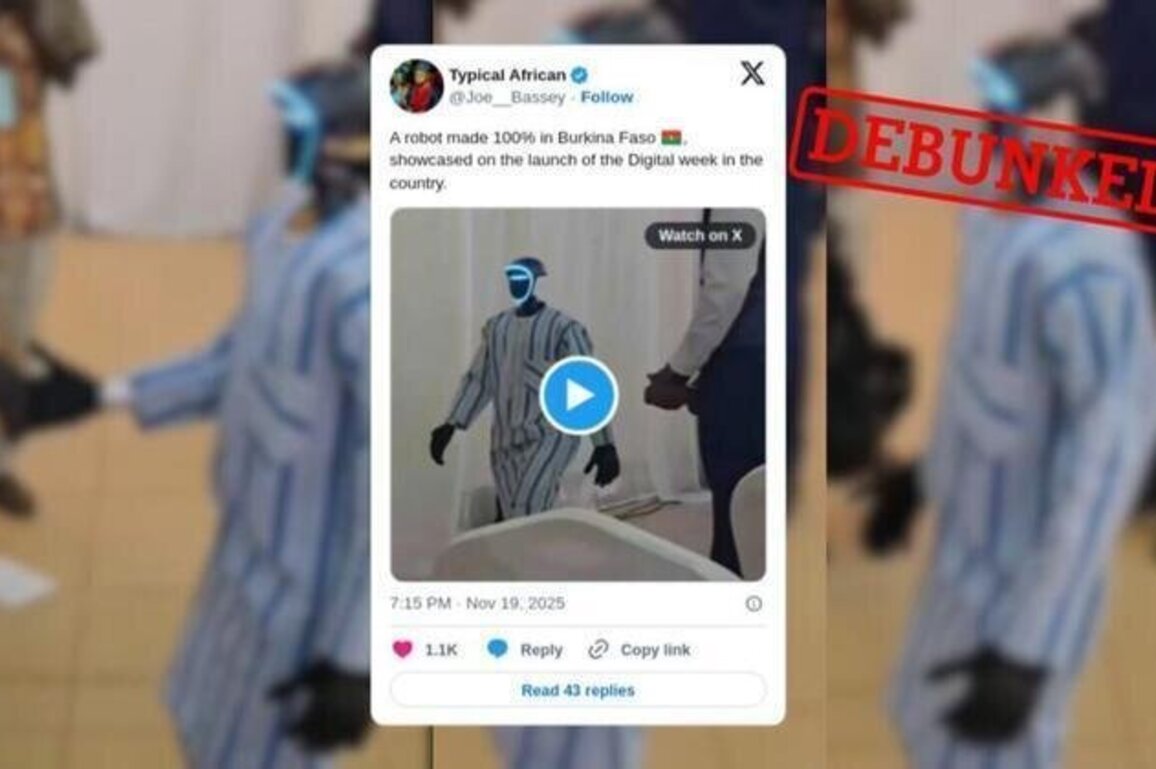
The opening of theDigital WeekinOuagadougouon November 18, a major event in the Burkinabe tech landscape, was marked by the sensational appearance of a mysterious robot.
Images of a humanoid robot, dressed in a traditional Burkinabe outfit, moving and interacting with visitors, flooded social media platforms likeXandTikTok. Online, the creation is being hailed as a model that is "100% made inBurkina Faso". One of the accounts that circulated the videos also shares content hostile to France.
These clips garnered several tens of thousands of views before being picked up by some African news outlets. For instance, the websiteTogoscoop Infoclaimed that the robot was entirely developed locally, from its mechanical architecture to its integrated control system".
In reality, the whole picture is more complex: the robot is not entirely made in Burkina Faso, even though local expertise was involved.
Chinese robot calibrated in Burkina Faso
A reverse image search conducted with screenshots from the video (see our guidehere) led to other sources documenting the robot. Franck Yacine Sawadogo, a design engineer at the Ministry of Digital Transition, clarified the device's origin in an article published on November 20 byBurkina 24. "These robots are not manufactured in Burkina Faso," he stated. "Our expertise consisted of programming these robots. When the models arrive, we proceed with their calibration, then their programming."
The article specifies that the machine is a G1 robot, a model produced by Unitree, a Chinese robotics company. This model can be found onUnitrees website.
However, Burkina 24 reported that the local expertise played a crucial role, though this expertise was not focused on the machines hardware design. In other words, while the robot wasnt manufactured in Burkina Faso, it was prepared, adapted and programmed there.
AI and technology serving political communication
This specific case is part of a broader pattern of exploiting new technologies and AI for political communication purposes.
In October 2025, images allegedly showing an ultramodern command centre for the AES (Alliance of Sahel States) were widely shared on social media, butthey turned out to be AI-generated.
Similarly, just a few months earlier,the Observers teamidentified several videos touting Burkina Fasos industrial success featuring tractors, smartphones, and agricultural machinery as digital propaganda created by AI.
Another video, presented as showing the construction of a railway in Burkina Faso, was also found to have been taken out of context and filmed in Malaysia.
AI has also been used to create videoscelebrating Burkina Faso's President, Ibrahim Traore, including fake music videos of stars like Beyonc or R. Kelly allegedly endorsing him.
This article has been translated fromthe original in French.
Originally published on France24