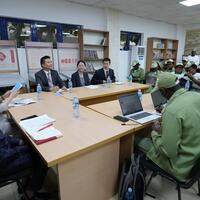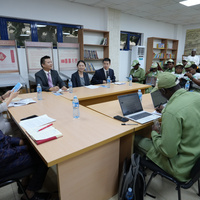


For the tenth year running, the Democratic Republic of Congo appears on the Norwegian Refugee Council's (NRC) annual list of top neglected displacement crises, and the neglect is deepening.
"This is a testament to the world's failure to respond to crises that are not regarded as strategically important for rich countries," said NRC's Secretary General Jan Egeland. "Millions of people are being abandoned because we have chosen not to act, not because we cannot. The uncomfortable truth is that this neglect is a choice, and something we can choose to end."
In 2025, just 27.4 per cent of the funding required to respond to the crisis in DR Congo was provided, the lowest rate in 10 years, leaving over 21 million people in need with no or drastically reduced assistance. A decade ago, the international community was providing 55 US dollars per person in need in DR Congo. Today that figure has collapsed to under 33 US dollars.
Countries such as Burkina Faso, Cameroon, Central African Republic, Mali and Nigeria have all featured on the list six or more times, pointing to a systemic pattern of deliberate neglect rather than isolated failure.
"Donor governments have been presented with evidence of neglect, year after year. Yet those in power still choose to prioritise military and strategic investments and underfund, deprioritise and sideline the victims of these crises. It is a failure of our humanity," said Egeland.
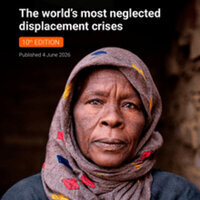
The report is the tenth edition of NRC's Neglected Displacement Crises Report, tracking how responses continue to fall short of the scale of suffering.
The 10 most neglected crises for 2025 are Sudan, the Democratic Republic of Congo, Colombia, Yemen, Afghanistan, Honduras, Ecuador, Cameroon, Nigeria and Mozambique, spanning three continents and tens of millions of people the world continues to ignore.
The Neglected Displacement Crises Report assesses each crisis across four indicators: media coverage, funding, political attention, and scale of displacement. A lower score indicates a larger gap between the scale of human suffering and the adequacy of international response.
Sudan tops this year's list. More than 9 million people are internally displaced, and up to 4 million have fled to neighbouring countries. Nearly 19.5 million people inside Sudan are facing hunger, yet the international response remains wholly inadequate to that scale of suffering.
"It is incomprehensible that a displacement crisis of similar proportions to the crises in Syria and Ukraine at their peak can continue to worsen almost unnoticed," Egeland said. "Just as needs in Sudan skyrocketed last year and famine kept spreading, the funding was cut. Many displaced people receive no international support and are left to beg for assistance from other displaced people who no longer have anything more to share."
Since NRC began publishing this report 10 years ago, 27 crises across four continents have appeared on the list, and the pattern is unambiguous. The African continent features the most consistently. From the Sahel region to the Horn of Africa, from the Great Lakes to West Africa, many of these are cases of prolonged or repeated displacement. Across the board, neglect coincides with access restrictions for humanitarians. With rare exceptions, the crises that were ignored a decade ago are still being ignored today. In DR Congo, the Ebola outbreak now spreading across eastern parts of the country - declared a public health emergency of international concern by WHO in May 2026 - is unfolding in communities already devastated by years of displacement and humanitarian neglect.
"Behind every statistic in eastern DR Congo are families who have endured years of violence, repeated displacement, and deep uncertainty about their future," said Eric Batonon, NRC's country director in the Democratic Republic of Congo. "While attention shifts from one global emergency to another, millions of Congolese continue to live without adequate protection, assistance, or hope. The fact that DR Congo remains among the world's most neglected crises for the tenth consecutive year should serve as a wake-up call to the international community."
The gap between needs and available humanitarian funding is increasing as a result of brutal humanitarian funding cuts. This is affecting the neglected crises particularly hard, as these crises are already characterised by less available funding per person in need.
NRC urges donor governments to fund crises based on humanitarian need and scale of displacement, not geopolitical interest. It calls on political leaders and diplomats to engage seriously with the root causes of protracted displacement, many of which persist precisely because they are seen as having little geopolitical importance. It also calls on media organisations to report on these crises with the consistency and depth they demand as ongoing emergencies.
"The crises ignored today will demand a larger, costlier and more complex response tomorrow," said Egeland. "The world does not lack for skills nor resources. Be it arranging football World Cups, or pioneering space exploration: our ability to organise and overcome challenges is almost without limit. We can and must finally take the decision to end the neglect that has caused such deep suffering for millions of people".
Multimedia:
Facts and figures:
For more information or to arrange an interview, please contact:
Source: Reliefweb